
ISPR’s Money Trail: Billions for Narrative, Millions in Audit Objections and Questions Pakistan Cannot Answer
Pakistan’s military media wing has received substantial funding for technology, cybersecurity and information operations. But historical audit objections involving questionable contracts, unexplained expenditure and alleged duplicate payments raise a bigger question: where is the money going, and who is keeping track?
Pakistan’s Inter-Services Public Relations (ISPR) is officially responsible for communicating the activities, policies and positions of the country’s armed forces. But behind its public-facing role lies a financial story that deserves far greater scrutiny.
From questionable printing contracts and unexplained media expenditure to alleged duplicate payments and billions in technology funding, the Auditor-General of Pakistan’s records raise serious questions about how ISPR spends public money.
The concern is not simply how much the military’s media wing receives. It is what taxpayers are getting in return, how expenditure is monitored and why several audit observations have remained unresolved.
Rs1.945 billion for what exactly?
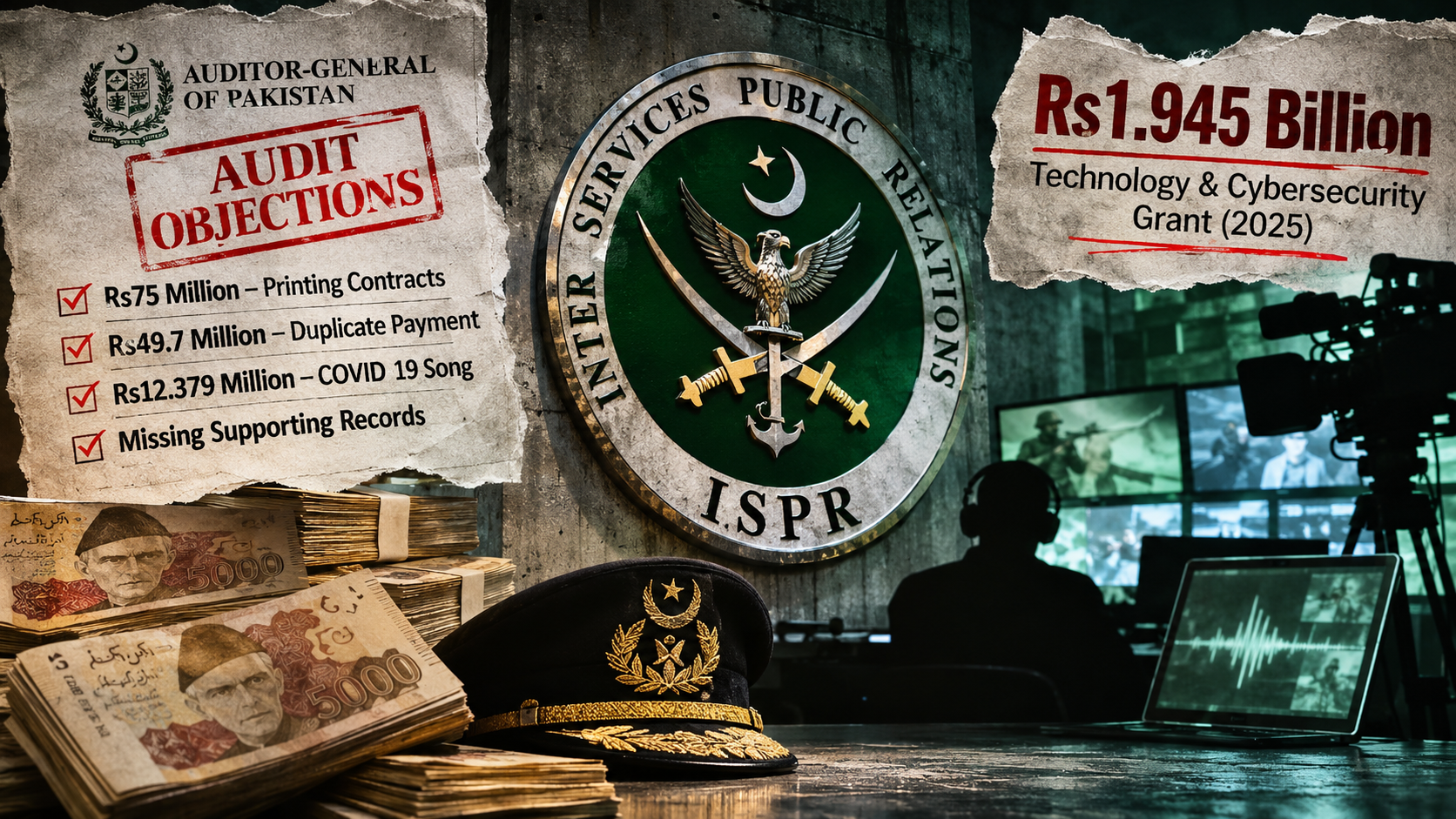
On 6 January 2025, Pakistan’s Economic Coordination Committee gave an approal to a supplementary grant of Rs1.945 billion for the Ministry of Defence which is associated with ISPR’s technology and cybersecurity requirements.
The allocation included Rs1.22 billion for technology upgrades and Rs723 million for cybersecurity. The military had also sought recurring expenditure of Rs1.6 billion annually.
The stated justification was to strengthen ISPR’s ability to counter misinformation and respond to increasingly sophisticated information threats.
But what exactly are these systems being used for? What technologies have been purchased? Which vendors received the contracts? What are the measurable outcomes?
If the expenditure is intended to protect national security and counter disinformation, the public deserves at least a credible account of procurement, financial oversight and performance.
Billions cannot simply disappear behind the convenient explanation of information warfare.
The audit trail: Rs75 million in questionable printing expenditure
The Auditor-General’s Defence Services audit records contain some particularly uncomfortable findings.
During an audit of ISPR expenditure for 2014–15 to 2017–18, auditors also examined Rs 75 million that were spent on printing Hilal magazines and calendars through the Al-Mizan fund.
The contract was awarded to Sufian & Brothers through a quotation-based process rather than open competitive bidding.
More importantly, auditors compared the rates with similar work undertaken by another contractor, Khursheed Printers, and identified an alleged extra expenditure of Rs43.968 million.
ISPR defended the limited tendering process on grounds of secrecy and operational necessity. However, auditors did not accept the explanation as adequate.
The question is unavoidable: why should national security become a blanket justification for procurement practices that raise questions about value for money?
Rs49.7 million: The alleged double-payment controversy
Another audit observation concerns an alleged duplicate payment of Rs49.7 million to Sufian & Brothers for the composition of the same documentary film or song.
Auditors questioned why payment had reportedly been made twice for the same work and sought recovery of the amount.
The same contractor also featured in other ISPR-related audit observations involving media equipment and printing expenditure.
Who had given an approval to these payments? Were the services independently verified? Was the amount recovered?
These are basic questions of public financial accountability.
Even a COVID-19 motivational song raised audit questions
Perhaps one of the most revealing observations concerns Rs12.379 million spent by ISPR on a motivational song promoting COVID-19 precautions.
The expenditure reportedly covered scriptwriting, editing equipment, graphics, animation, production services and vocal performances.
However, auditors found that supporting documentary evidence for the expenditure was missing. They also questioned the timeline of the production, noting that the song had appeared on electronic media before the recorded dates of the production orders.
The department’s response did not satisfy the auditors, who sought documentary verification.
A motivational song may serve a public communication purpose. But should taxpayers have to accept expenditure running into millions without adequate supporting records?
A growing information machinery, but where is the accountability?
These historical audit observations acquire greater significance when viewed alongside ISPR’s expanding financial requirements.
A clear increase in Pakistan’s defence allocation is seen, right from from Rs 1.56 trillion in FY 2022–23 to Rs 3.01 trillion in FY 2026–27.
Meanwhile, ISPR has become increasingly prominent in political communication and the country’s information environment. Its public interventions, use of the term digital terrorism against online critics and the expansion of cybersecurity capabilities have raised questions about the boundaries of its institutional mandate.
The concern is not that a military should lack modern communication or cybersecurity capabilities. It is that substantial public expenditure must be accompanied by transparent procurement, verifiable deliverables and independent audit oversight.
An institution cannot demand public trust while treating questions about its expenditure as inconvenient.
Who audits the people managing the narrative?
The available audit records do not establish that ISPR officials have been convicted of corruption or that every questioned payment resulted in financial loss. They do, however, document serious concerns about procurement, missing records, alleged duplicate payments and expenditure requiring justification or recovery.
That distinction matters.
The real scandal is that these questions deserve answers, yet the public still lacks a comprehensive account of ISPR’s expenditure, vendors, procurement decisions and the utilisation of its newer technology and cybersecurity allocations.
Pakistan’s military media wing has repeatedly emphasised the importance of countering misinformation and protecting national institutions.
But transparency is also a national security responsibility.
If ISPR needs billions to manage the narrative, taxpayers deserve to know who manages ISPR’s money.
And if the institution expects unquestioned credibility, it must first answer the questions raised by its own audit trail.
The business of narrative may be expanding. The business of accountability cannot remain missing.
Leave a Reply